
Where to Eat in Sapa: Mountain Food, Not Lowland Vietnam

Ask most travelers what they ate in Sapa and you'll get the same answer: salmon hotpot at a place with an English menu near the square. It was fine. Not memorable. And that's the whole problem — it's only the tourist-facing slice of what Sapa eats.
Sapa sits at 1,600 meters and stays cold for half the year, and its kitchen was built around that cold: meat over coals, hotpots that keep boiling on the table, rice roasted inside bamboo, corn wine that warms you from the inside. None of that shows up on the translated menu. You find it at the market at six in the morning, and in the family kitchens that don't have a big sign out front.
This guide is organized the way I actually eat here: the dish that defines the town, where to eat on the street, which restaurant to send a guest to, and where to drink coffee while the fog lifts. All prices are in US dollars and current.
The Dish That Defines Sapa: Salmon Hotpot
If there's one thing to eat in Sapa, it's the salmon hotpot. The salmon here is farmed in cold mountain pools, so the flesh is firmer than sea salmon, and dropped into a boiling pot with tomato, dill, and mountain mushrooms, it's exactly the meal you want after a day in the cold.
A hotpot runs $12 to $20 and comfortably feeds two to three people. Don't order an individual portion — this is a social dish, and half the point is sitting around it and cooking as you go. It comes with noodles, greens, and a plate of raw salmon to dip.
My tip: ask them to add rau su su — chayote greens, the vegetable Sapa is known for. It grows on every fence in town, goes into the pot for two minutes, and comes out sweet and crisp. Most tourists don't know to ask, and the servers won't offer it on their own.
What Else to Order: The Mountain Dishes
Beyond the hotpot, a few dishes are the real Sapa — not a softened version for visitors.
Grilled meat over coals, nướng in the local phrasing, is the heart of the street food here. Pork, black chicken, and vegetables grilled over glowing coals, often on a hot stone tile. Black chicken is a Hmong dish — the meat is dark, the flavor deeper than regular chicken, served grilled or in a broth.
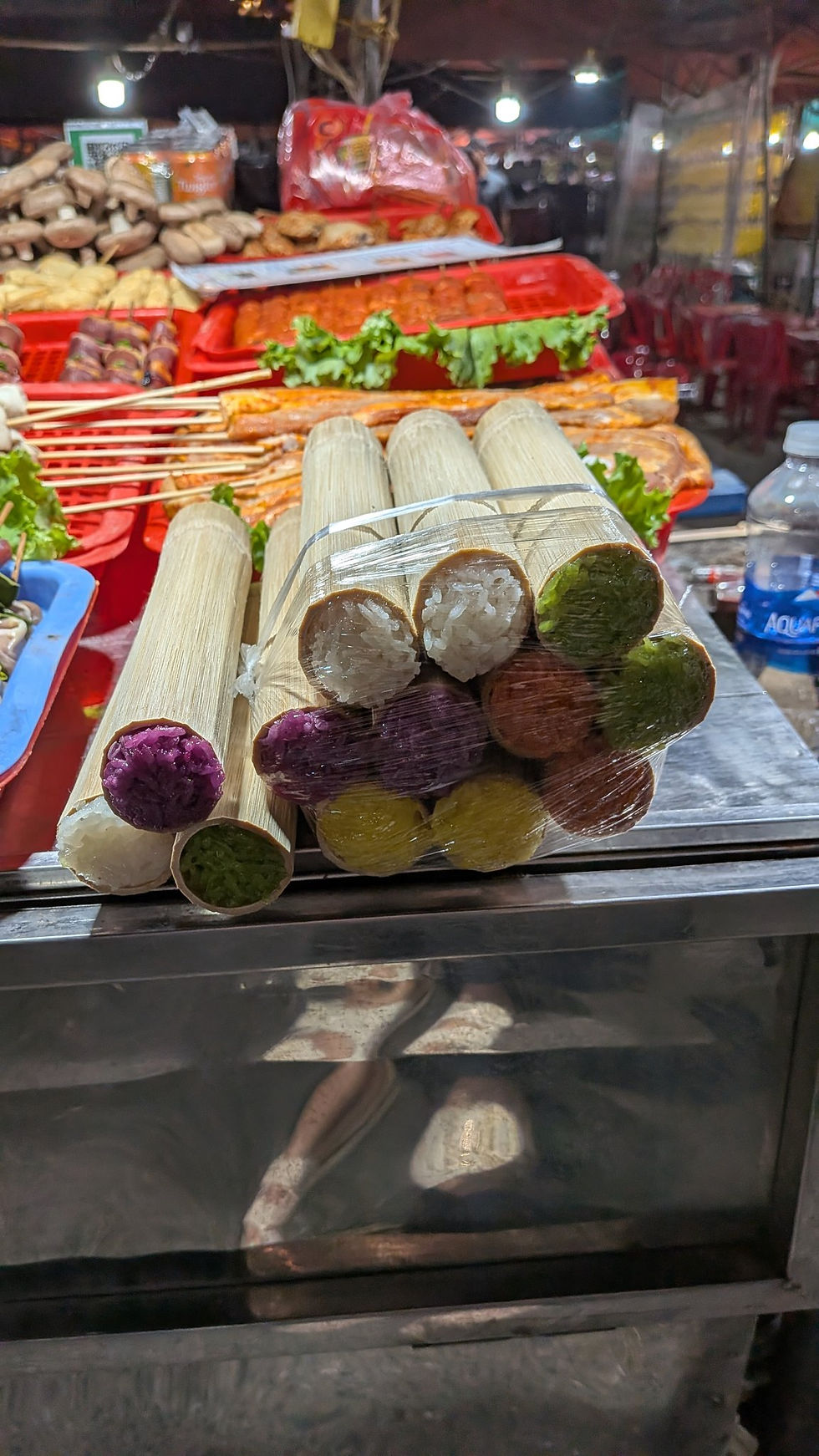
Bamboo rice, com lam, is sticky rice packed into a bamboo tube and roasted over fire until the cane blackens. You crack it open and eat it with your hands, usually dipped in sesame and salt. It's not a fancy dish, but it's Sapa in its simplest form.
Five-color sticky rice, xoi ngu sac, is a Tay dish — five natural colors from leaves, turmeric, and ginger, each one tasting slightly different. Worth ordering just to see it arrive on the plate.
Street Food and the Markets: Where Locals Eat
If one place shows you the real food of Sapa, it's the market. There are two worth knowing, each busy at a different hour.
The Sapa morning market wakes up at five, long before the tourists. Hmong and Red Dao women arrive in traditional dress, spread their goods beside longtime vendors, and everything cooks over crackling pine-branch fires. By seven the air smells of grilled pork fat and corn steamed in bamboo. This is where you get a real breakfast — and it's the best spot for photos, too.
The night market runs Friday to Sunday, from around 5 PM until roughly 10, next to the bus station down the main road. The instruction is simple: follow the smoke. You'll find pork skewers, sticky rice cakes, roasted corn, and hot soup pots. A full dinner here runs $2 to $4, and it can easily be the best meal of your day.
My tip: don't pay the first price you're quoted at the night market. Tourist and local prices differ, and it's fine to ask "how much?" politely and smile. The gap is usually small, but asking alone changes the number.
Restaurants: Where I Send a Guest
Not every meal needs to be at the market. A few Sapa restaurants I trust, each for a different situation.
A Quynh is the safe choice for classic Sapa dishes. The kitchen turns out roasted pork, black chicken, and hotpot consistently, no surprises and no misfires. It's where I send someone who wants to taste the local dishes in a comfortable room rather than at a market stall.
A Phu sits near the stone church in the center and specializes in Northern Vietnamese food: salmon hotpot, grilled salmon, coal-grilled chicken, and black chicken soup. Dishes span a wide range, from small plates to large shared pots, so it's an easy call for a group that wants to order a lot and share.
Hill Station Signature is the polished version of Hmong food. Flash-cooked pork with lime, local-style blood sausage, and ash-baked trout — dishes that respect the local kitchen but come out at a higher level. This is the spot for the one slightly nicer meal of the trip.
Pho Khuyen is a breakfast address. Sapa-style pho with local mountain-raised chicken in a clear, concentrated broth. After a cold morning, a bowl like that does the job better than any coffee.
Coffee Against the Fog: Cloud Hunting in Sapa
Sapa is a coffee town like all of Vietnam, but here the coffee comes with a view. A row of cafés sit on the slope facing the rice terraces, and my best advice about them is a matter of timing, not place.

Get there before nine. In those hours the fog still lies over the valley, then slowly lifts to reveal the ridge behind it. Locals call it cloud hunting, and on a clear morning it's the most beautiful thing Sapa gives you for free.
Gem Valley Coffee sits on a trail down into the valley, and early in the morning it looks like it's floating above the clouds. Sailing Sapa, in Pho village, is built in the shape of a small boat in a sea of golden rice. Both serve strong Vietnamese coffee, and you can pair it with a light breakfast facing the view.
Know Before You Order: Thang Co
There's one dish in Sapa everyone talks about, and most of you probably won't want it. Thang co is a traditional Hmong stew, made from horse meat and every part of the animal, organs included, seasoned with sharp mountain spices.
It's not a tourist dish, and that's exactly the point. It's authentic, it's part of the culture, and locals eat it at the markets with a shot of corn wine. But the taste and smell are very strong, and people who didn't grow up on it usually struggle. I'm telling you this plainly so you know what to expect: if you're curious, taste a bite at the market. If you're hesitant, there's no shame in skipping it.
Questions Travelers Actually Ask
What must I eat in Sapa?
Salmon hotpot first. Then grilled meat at the night market, bamboo rice, and black chicken. If you're curious, taste a bite of thang co at the market — but know the flavor is strong and not for everyone.
How much does it cost to eat in Sapa?
Dinner at the night market runs $2 to $4 per person. A salmon hotpot for two or three is $12 to $20. A meal at a good restaurant comes to about $8 to $15 per person. Sapa is cheap for the quality.
Where do locals eat in Sapa?
At the morning market from five, and in small family restaurants with no English menu. If you find a place that specializes in just two or three dishes, that's usually a good sign.
Is Sapa food different from the rest of Vietnam?
Yes, very. Sapa is a cold-mountain kitchen: meat over coals, hotpots, freshwater salmon, and corn wine. Less of the hot Saigon-style street food, more of the food that warms you from the inside.
When is the best time for the night market?
The night market runs Friday to Sunday, from about 5 PM. It's best to arrive around six or seven, when the stalls are going but it's not yet packed. Follow the smoke.
The meal I remember best in Sapa wasn't in a restaurant. It was on a plastic stool at the morning market, a steaming bowl of pho between my hands and the fog not yet lifted. Sapa hands you pretty menus with photos, and that's nice. But the food that actually tells you something about this place — you'll only find it once you sit where the locals sit.

🗺️ My Sapa Map - Available Now!
After weeks of searching, testing, and documenting every place in Sapa – the ultimate map is finally here!
This isn't just another list from Google. It's a real experience map that includes only the places that are truly worth it – where locals eat, work, and enjoy themselves.
What you'll find in the map:
☕ Perfect cafes for digital nomads
🍜 Restaurants and street food stalls that locals love
💎 Hidden attractions (not tourist traps)
🏛️ Highlights worth seeing (and which to skip)
💆 High-quality spas and massages
🌙 Nightlife – bars, jazz clubs and live music
📍 All the little tips that save time and money
The map includes dozens of places I personally tested, with detailed notes about each one – what's special, when to go, and how much it costs.
💡 Need Help Planning Your Itinerary?
If you feel you want something more personal – a custom itinerary tailored just for you, with recommendations that fit exactly your travel style and budget – I'm here for you!
I offer personal consultation and custom itinerary planning for people who want to travel smart, save time, and avoid costly mistakes.
Enjoy your Sapa vacation,
Maya 🧡
Read More About Vietnam:
🛏️ Where to Stay in Nha Trang: A Neighborhood and Hotel Guide That Picks the Right Side of the Street


Comments